


في هذا المقال
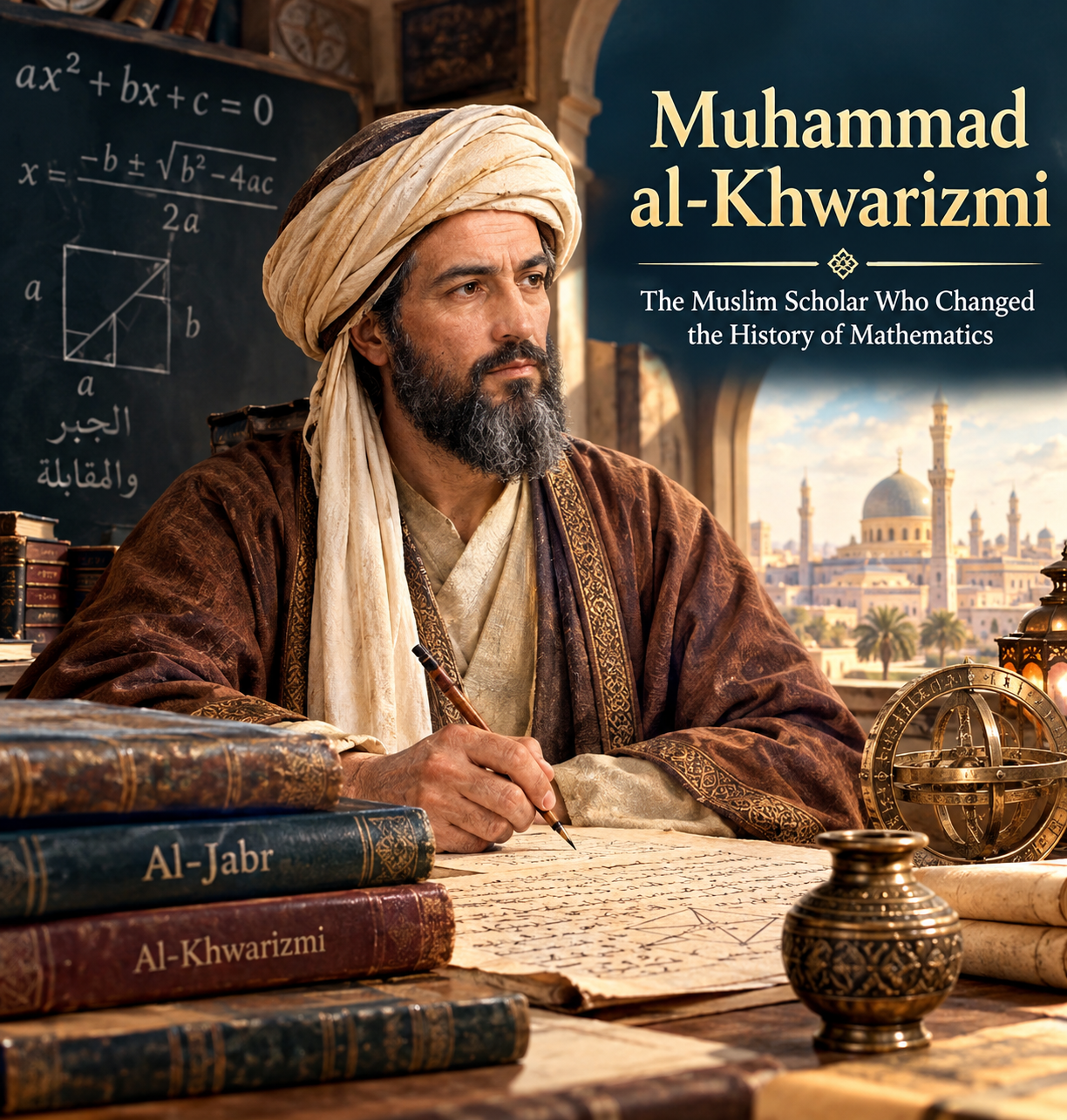
Introduction: Why Muhammad al-Khwarizmi Still Matters
What connects a school student's algebra lesson, a bank's financial calculations, and the software running on a modern computer? One important link is the history of mathematical methods developed and transmitted across civilizations, including the work of Muhammad ibn Musa al-Khwarizmi.
Al-Khwarizmi was a pioneering mathematician and scholar who worked during the Islamic Golden Age, a period of remarkable intellectual activity under the Abbasid Caliphate. His writings helped establish systematic methods for solving mathematical problems, explain Indian numerical techniques to new audiences, and advance astronomy and geography.
His legacy survives in two familiar words: algebra, derived from the title of his influential mathematical treatise, and algorithm, which developed from the Latinized form of his name. Although he did not invent modern computers, his work occupies an important place in the long history of mathematical reasoning and calculation.
Muhammad al-Khwarizmi's Life and the Islamic Golden Age
Baghdad: A Center of Learning
Muhammad al-Khwarizmi probably lived from around 780 to around 850 CE, although the precise dates of his birth and death remain uncertain. His name connects him with Khwarazm, a historical region in Central Asia associated with parts of present-day Uzbekistan and Turkmenistan.
He worked during the Abbasid Caliphate, when Baghdad became one of the world's leading centers of scholarship. Abbasid rulers and other patrons supported the study, translation, and development of knowledge drawn from Greek, Persian, Indian, and other intellectual traditions.
Al-Khwarizmi is closely associated with the scholarly environment surrounding the House of Wisdom, or Bayt al-Hikma, in Baghdad. This institution is often linked with the preservation and study of scientific texts. However, the exact organization of the institution and the details of al-Khwarizmi's employment there are not fully documented.
What is clear is that scholars in this period did more than preserve earlier knowledge. They compared ideas, adapted mathematical techniques, and developed new approaches to practical and theoretical problems.
Al-Khwarizmi's work reflects this international exchange of knowledge. His surviving writings demonstrate the importance of Indian mathematical traditions, while his geographical and astronomical research engaged with earlier Greek and other scientific sources.
The Major Scientific Achievements of Al-Khwarizmi
1. Algebra: A New Way to Solve Equations
Al-Khwarizmi's most famous mathematical work is The Compendious Book on Calculation by Completion and Balancing, commonly known by its Arabic title, Al-Kitab al-Mukhtasar fi Hisab al-Jabr wa al-Muqabala.
Written in the early ninth century, the book presented systematic procedures for solving linear and quadratic equations. It explained how mathematical quantities could be rearranged and balanced to find unknown values.
The word al-jabr, meaning restoration or completion in this mathematical context, eventually gave English the word algebra.
Consider a simple modern example:
[
x+5=12
]
A student today subtracts five from both sides to find (x=7). Al-Khwarizmi's book used the mathematical language and methods of its own time rather than modern symbolic notation, but it similarly emphasized organized procedures for solving equations.
His treatment of algebra was especially influential because it presented the subject as a systematic discipline with practical applications. The book addressed problems involving inheritance, commerce, land measurement, and other everyday concerns.
Al-Khwarizmi did not invent every idea that appeared in his work. Earlier civilizations had developed mathematical techniques for solving equations. His achievement was to organize and explain important methods in a form that influenced later mathematical scholarship.
2. Hindu-Arabic Numerals and Decimal Calculation
Another major contribution associated with al-Khwarizmi was his explanation of Indian mathematical methods, including the decimal positional number system.
Today, many people use the digits 0 through 9 without thinking about the history behind them. In a positional system, a digit's value depends on where it appears. For example, the digit 2 represents two in 2, twenty in 20, and two hundred in 200.
This system makes arithmetic more efficient than many older numerical methods. The use of zero as a placeholder is particularly important because it allows numbers such as 205 and 2,005 to be represented clearly.
Al-Khwarizmi's original Arabic arithmetic treatise has been lost, so scholars cannot reconstruct every detail of its contents with certainty. Nevertheless, a medieval Latin tradition associated with his name helped transmit Indian numerical methods into Europe.
His role should therefore be understood as part of a broader history of mathematical exchange. Indian scholars developed the underlying numeral system, scholars in the Islamic world studied and transmitted it, and European mathematicians gradually adopted it.
3. Algorithms: The Origin of a Modern Word
The word algorithm is another enduring part of al-Khwarizmi's legacy. It developed from Latinized forms of his name, which appeared in medieval works associated with numerical calculation.
An algorithm is a clearly defined sequence of steps for completing a task or solving a problem. For example, the instructions for adding two numbers, sorting a list, or calculating a percentage can be expressed as an algorithm.
Medieval Latin translations of mathematical works associated with al-Khwarizmi helped spread computational techniques in Europe. Over time, terminology connected with his name became associated with systematic calculation and eventually developed into the modern word algorithm.
This connection makes al-Khwarizmi relevant to the history of computer science. Modern software relies heavily on algorithms, but it would be misleading to claim that al-Khwarizmi directly invented computer programming. His importance lies in his contribution to the longer intellectual tradition of organizing mathematical procedures into repeatable steps.
4. Astronomy: Calculating the Movements of Celestial Bodies
Al-Khwarizmi also contributed to mathematical astronomy. He produced astronomical tables, often described as zij, that supported calculations involving celestial bodies and calendars.
His astronomical work drew significantly on Indian traditions and also belonged to a scholarly environment familiar with Greek astronomy. Such tables helped astronomers calculate celestial positions and investigate questions involving timekeeping and the calendar.
Astronomy was not merely theoretical during the Abbasid period. It had practical applications in determining times, developing calendars, navigation, and other activities requiring careful observation and calculation.
Al-Khwarizmi's astronomical writings demonstrate the breadth of his interests and the close relationship between mathematics and the observational sciences.
5. Geography: Improving Knowledge of the World
Al-Khwarizmi made important contributions to geography through a work commonly known as The Image of the Earth, or Kitab Surat al-Ard.
The work dealt with geographical coordinates and information about places, including settlements, regions, mountains, rivers, and other features. It engaged with the geographical tradition of the Greek scholar Claudius Ptolemy while incorporating revised information.
This research formed part of a broader Abbasid effort to collect, compare, and improve geographical knowledge. Mathematical geography was valuable for understanding the location of places and producing maps.
Al-Khwarizmi's work illustrates how scholars in the Islamic Golden Age combined inherited knowledge with new calculations and information. It also shows why his achievements cannot be reduced to algebra alone.
Muhammad al-Khwarizmi: Historical Timeline
The following timeline summarizes the broad historical setting of his life and influence. Dates are approximate because many details of his biography and the composition of his works remain uncertain.
| Period | Historical Context | Scientific Contributions |
|---|---|---|
| Late 8th century | Abbasid rule and the growth of scholarship | Early life and education; specific details are uncertain |
| Early 9th century | Baghdad develops as a major center of learning | Mathematical, astronomical, and scholarly activity |
| First half of the 9th century | Abbasid intellectual life flourishes | Influential works on algebra, arithmetic, astronomy, and geography |
| 12th century | Scientific texts circulate through Latin translation | Wider European access to mathematical methods associated with al-Khwarizmi |
| Later medieval period | European mathematical learning develops through multiple traditions | Growing use of Hindu-Arabic numerals and computational techniques |
How Al-Khwarizmi Influenced the Modern World
Al-Khwarizmi's influence can be seen in several connected areas of modern life.
First, algebra remains essential in education, science, engineering, economics, and technology. The systematic treatment of equations helped establish a tradition in which mathematical problems could be expressed and solved through organized procedures.
Second, the spread of Hindu-Arabic numerals transformed calculation. Positional notation and zero made many forms of arithmetic easier to perform and communicate. Their adoption in Europe took time and involved the contributions of numerous scholars and translators.
Third, the history of algorithms links medieval mathematical reasoning with contemporary computing. Every computer program depends on instructions that can be followed systematically. Although modern algorithms emerged through centuries of developments by many people, al-Khwarizmi's place in the history of calculation remains significant.
Finally, his work illustrates the international character of scientific progress. Mathematical knowledge did not develop in isolation within one civilization. Indian, Greek, Persian, Arabic-speaking, and European scholars contributed to a continuing exchange of ideas across languages and generations.
Frequently Asked Questions About Muhammad al-Khwarizmi
Who was Muhammad al-Khwarizmi?
Muhammad ibn Musa al-Khwarizmi was a mathematician, astronomer, and geographer who worked during the Abbasid Caliphate in the early ninth century. He is best known for his influential work on algebra and numerical calculation.
When and where did he live?
He probably lived from around 780 to around 850 CE. He worked in Baghdad, the Abbasid capital, but the precise dates and details of his early life are uncertain.
What was his most important contribution?
His algebra treatise is widely regarded as his most influential mathematical achievement. It presented systematic methods for solving linear and quadratic equations and helped establish algebra as a distinct field of study.
Why is he associated with the word algorithm?
The word algorithm developed from Latinized forms of al-Khwarizmi's name used in the medieval transmission of mathematical works associated with him.
How did his work influence European mathematics?
Latin translations of works associated with al-Khwarizmi helped European scholars learn mathematical procedures and Hindu-Arabic numerical methods. These developments contributed to the gradual transformation of European arithmetic and algebra.
Why is al-Khwarizmi still remembered today?
He is remembered for his role in the history of algebra, numerical calculation, astronomy, and geography. His legacy also highlights the importance of intellectual exchange between civilizations.
Conclusion: The Lasting Legacy of Muhammad al-Khwarizmi
Muhammad al-Khwarizmi stands among the most influential scholars of the Islamic Golden Age. His work on algebra helped organize methods for solving equations, while his writings on arithmetic, astronomy, and geography contributed to the development and transmission of mathematical knowledge.
His influence should not be exaggerated: he did not single-handedly create modern mathematics or invent computers. Rather, he helped advance a tradition of systematic reasoning that later scholars continued to develop.
Remembering Muhammad al-Khwarizmi also reminds us that scientific progress is a shared human achievement. Ideas travel across borders, languages, and generations, gaining new applications along the way. By studying his legacy, we gain a deeper appreciation of both the history of mathematics and the diverse civilizations that helped shape the modern world.
References and Further Reading
MacTutor History of Mathematics Archive, University of St Andrews. “Al-Khwarizmi.” A scholarly biography covering his mathematical, astronomical, and geographical work.
MacTutor History of Mathematics Archive, University of St Andrews. “Arabic Numerals.” A historical discussion of the transmission of Indian numerical methods and the evidence surrounding al-Khwarizmi's arithmetic treatise.
Crossley, John N., and Alan S. Henry. “Thus spake al-Khwārizmī: A translation of the text of Cambridge University Library Ms. Ii.vi.5.” Historia Mathematica, vol. 17, no. 2, 1990, pp. 103–131. DOI: 10.1016/0315-0860(90)90048-I.
These references provide starting points for readers who want to explore the historical evidence and the development of mathematics in greater depth.
تابع جديد K Q
اختر إشعارات الموقع أو البريد أو الاثنين. الزائر يقدر يشترك ببريده دون تسجيل حساب.
الإبلاغ عن المقال
لو لاحظت مشكلة في المحتوى، أرسلها لفريق المراجعة. لن تظهر بياناتك لكاتب المقال أو للقراء.
تعذّر إرسال البلاغ الآن. حاول مرة أخرى لاحقًا.
سجّل الدخول لإرسال بلاغ







النقاش
التعليقات (0)
فكرة تضيفها، أو سؤال يفتح حوارًا.
الرجاء تسجيل الدخول لتتمكن من التعليق