


In this article
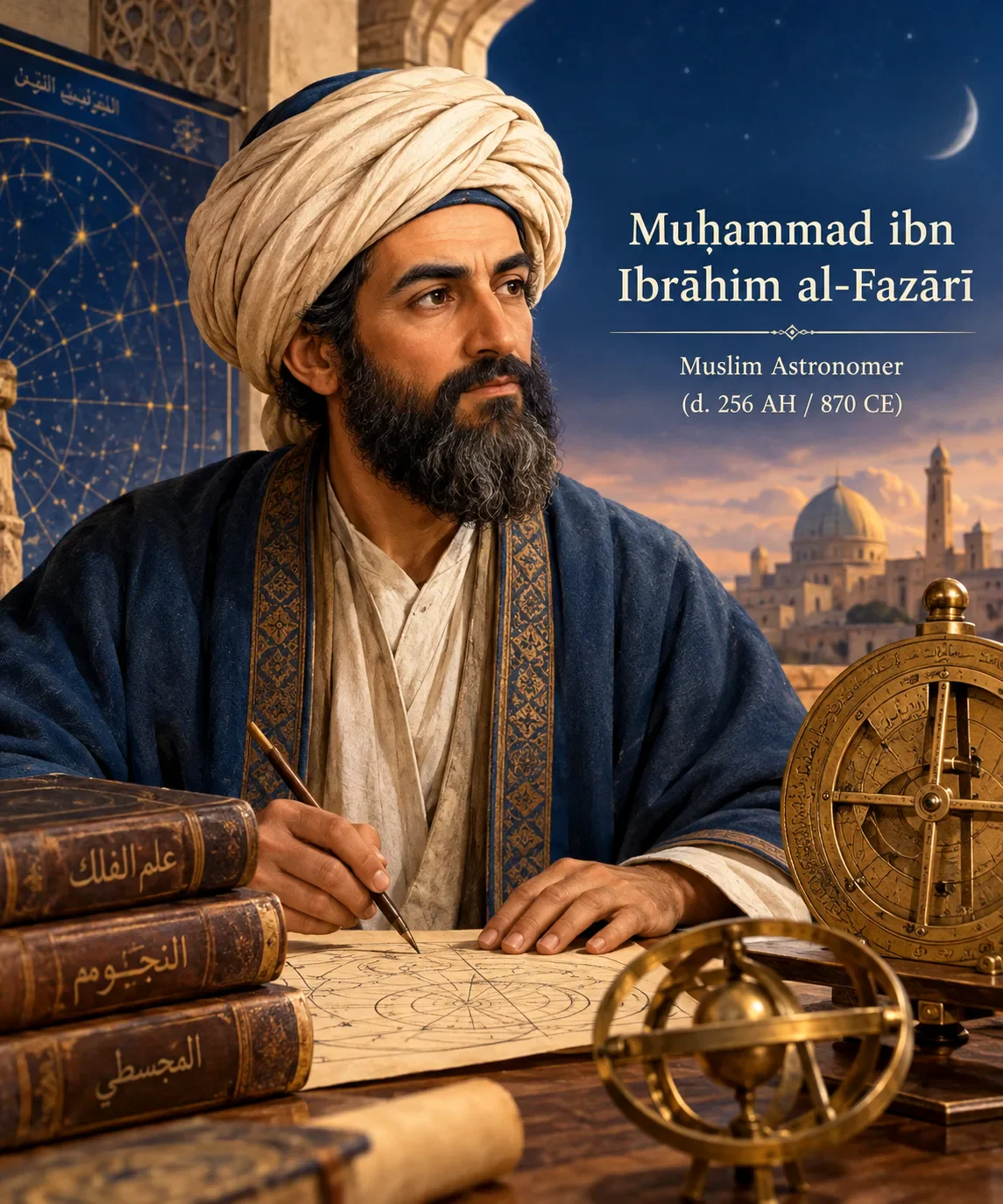
Muhammad ibn Ibrahim al-Fazari: The Muslim Astronomer Who Helped Shape the History of Astronomy
Introduction: The Astronomer Who Helped Build a Scientific Tradition
How did ancient observations of the stars become the foundation for a sophisticated tradition of mathematical astronomy? One important part of the answer lies in the work of early scholars who translated, studied, and adapted scientific knowledge from different civilizations.
Among these scholars was Muhammad ibn Ibrahim al-Fazari, an astronomer associated with the early Abbasid period of Islamic history. Active during the eighth century or around the turn of the ninth, al-Fazari became known for his role in the transmission of Indian astronomical knowledge into Arabic and for his contributions to astronomical tables and instruments.
His importance extends beyond any single book or discovery. Al-Fazari represents an early stage in the development of Arabic-language astronomy, when scholars brought together Indian mathematical methods, Persian astronomical traditions, and elements of Greek science.
Although most of his original writings have not survived, later historical accounts preserve evidence of his work. His story reveals how scientific progress often begins with the careful study and adaptation of knowledge developed by earlier generations.
Who Was Muhammad ibn Ibrahim al-Fazari?
Muhammad ibn Ibrahim al-Fazari was an early Muslim astronomer and scholar associated with the Abbasid intellectual world. Historical biographical accounts connect him with Kufa, an important center of learning in present-day Iraq, and with the court of the Abbasid caliph al-Mansur.
Unfortunately, little reliable information survives about his personal life. Historians have reconstructed his career mainly from references in later Arabic scientific and biographical works.
The Problem of His Identity
One important challenge concerns the relationship between Muhammad ibn Ibrahim al-Fazari and Ibrahim ibn Habib al-Fazari. Some medieval sources appear to distinguish them as father and son, while others contain confusing or overlapping information about their identities and achievements.
This distinction matters because certain works and achievements associated with the name al-Fazari may not always have been attributed consistently.
The scholarly biography by Kim Plofker, published through the Biographical Encyclopedia of Astronomers and made available by the Islamic Scientific Manuscripts Initiative, discusses this uncertainty. It treats the different references to the astronomer as probably referring to the same individual for the purposes of reconstructing his scientific career.
Consequently, it is more accurate to describe al-Fazari's life in terms of the historical evidence than to present every traditional biographical detail as certain.
The Abbasid Golden Age and the Growth of Astronomy
The Abbasid Revolution brought a new dynasty to power in 750 CE. Under early caliphs such as al-Mansur, who ruled from 754 to 775, the expanding Abbasid state became an important setting for the study of mathematics, astronomy, medicine, and other scholarly disciplines.
Astronomy had practical as well as intellectual value. Astronomical calculations helped scholars develop calendars, estimate the positions of celestial bodies, study planetary movements, and determine times associated with daily life and religious observance.
The intellectual environment of this period encouraged scholars to investigate scientific works from different regions. Indian astronomical texts offered mathematical techniques and planetary models, Persian traditions contributed additional astronomical parameters and computational practices, and Greek learning provided another influential source of ideas.
These traditions did not simply merge into one uniform system. Scholars compared different methods, adapted calculations, and sometimes encountered inconsistencies that required further investigation.
Baghdad as a Center of Knowledge Exchange
The foundation of Baghdad in 762 CE under al-Mansur helped establish a major political and intellectual center. Historical accounts associate al-Fazari with the scholarly activities surrounding the early Abbasid court, including astronomical work connected with the city's foundation.
In the early 770s, an Indian astronomical text was reportedly brought to Baghdad by an Indian scholar or diplomatic delegation. Al-Fazari and other scholars, including Yaqub ibn Tariq, became associated with its translation and adaptation.
This activity helped establish an important precedent: scientific knowledge could cross linguistic and cultural boundaries and become the starting point for further research.
The organized translation movement expanded in later decades, especially under subsequent Abbasid rulers. Al-Fazari therefore belongs to the formative period of a much longer scientific tradition rather than to a completed Golden Age.
Al-Fazari's Contributions to Astronomy
One of al-Fazari's most important reported contributions was his work on astronomical handbooks known as zijes.
A zij is a collection of astronomical tables, often accompanied by instructions explaining how to use them. Such works could help a trained reader calculate the positions of the Sun, Moon, and planets for particular dates.
Before modern computers, these tables were essential computational tools. Instead of repeating every complex astronomical calculation from the beginning, users could consult prepared numerical tables and apply established procedures.
Zij al-Sindhind al-Kabir
The work most closely associated with al-Fazari is Zij al-Sindhind al-Kabir, commonly translated as the Great Astronomical Tables of the Sindhind.
The term Sindhind is associated with the Sanskrit word siddhanta, meaning a system or treatise. Historical accounts connect the work with an Indian astronomical text brought to the Abbasid court and translated into Arabic during the early 770s.
The underlying material belonged to a broader Indian astronomical tradition associated with works such as the Mahasiddhanta. However, the resulting Arabic astronomical handbook was not necessarily a direct, word-for-word translation of a single surviving Sanskrit text.
Evidence discussed by modern historians suggests that it combined Indian methods with material from Persian astronomical traditions and some Greek, particularly Ptolemaic, influence.
This mixture is significant. It shows that early Islamic astronomy developed through active scholarly adaptation rather than through the passive copying of a single civilization's achievements.
The original work has not survived intact. Its contents are reconstructed from scattered quotations, later commentaries, and historical reports. Nevertheless, its reputation indicates that it was an important early contribution to the development of astronomical calculation in Arabic.
Zij 'ala Sini al-Arab
Another work attributed to al-Fazari is Zij 'ala Sini al-Arab, meaning astronomical tables according to the years of the Arabs.
The title suggests that the tables were designed to support calculations using the Arabic calendar. This was important because astronomical predictions had to be related to specific dates, and different calendar systems used different ways of organizing time.
Adapting astronomical tables to the Arabic calendar made them more useful within their intended context. It also illustrates how scientific knowledge could be adjusted to meet the practical needs of a new scholarly community.
Together, these two works demonstrate al-Fazari's association with an emerging tradition of numerical astronomy.
Al-Fazari and the Astrolabe
The astrolabe was one of the most remarkable astronomical instruments used in the medieval world. Its earlier history predates al-Fazari, so he should not be described as the inventor of the instrument itself.
A traditional astrolabe uses a graduated circular plate and a rotating framework to represent aspects of the sky. Depending on its design and how it is used, it can help determine the altitude of celestial objects, estimate local time, and solve certain problems involving the positions of stars and the Sun.
Historical biographical accounts credit al-Fazari with an early role in constructing or developing the plane astrolabe in the Islamic world. Some accounts describe him as the first Muslim to make such an instrument.
That attribution should be understood in its historical context: it concerns the instrument's early development within the Islamic scientific tradition, not the original invention of the astrolabe across all civilizations.
Why the Astrolabe Mattered
The astrolabe transformed mathematical descriptions of the sky into a practical instrument. A trained user could combine its markings, movable parts, and observational measurements to solve astronomical problems.
Its applications included estimating the altitude of the Sun or stars, assisting with timekeeping, and supporting calculations connected with celestial positions. Its use also became important in later Islamic traditions of astronomy and timekeeping.
Works attributed to al-Fazari include a treatise on the use of the plane astrolabe and another concerning an instrument described as an armillary astrolabe or sphere. These titles survive in bibliographical references, although the complete works are not available for modern examination.
Al-Fazari's association with these instruments reflects the close relationship between mathematical theory and practical scientific tools in early Islamic astronomy.
His Role in the Translation of Indian Astronomy
The transmission of Indian astronomy into Arabic was one of the important developments of the early Abbasid period.
Indian astronomers had developed sophisticated mathematical methods for representing planetary movements and calculating celestial positions. When these methods became available to Arabic-speaking scholars, they provided new resources for astronomical research.
Al-Fazari's name is closely connected with the translation of the Sindhind tradition. Historical reports place this work in the early 770s, when an Indian astronomical text was studied at the Abbasid court.
The translation is also associated with Yaqub ibn Tariq, indicating that the process involved more than one scholar. Collaboration was particularly important because technical texts could contain unfamiliar terminology, numerical procedures, and astronomical assumptions that required careful interpretation.
Translation Was Only the Beginning
Translating a scientific work did not automatically guarantee that every calculation or explanation was understood correctly. Astronomical systems often depended on specialized mathematical conventions, and translators had to decide how best to express these concepts in another language.
The eleventh-century scholar al-Biruni later discussed early astronomical traditions and noted problems in the interpretation of some Indian material by al-Fazari and Yaqub ibn Tariq.
Such criticism is an important part of the history of science. It demonstrates that scientific traditions develop through examination, correction, and debate, not through the unquestioning acceptance of earlier authorities.
Nor should al-Fazari be credited with introducing every Indian mathematical or astronomical idea into the Islamic world. The transmission of knowledge was a broader process involving multiple scholars, texts, and generations.
His importance lies in his association with one of the formative stages of that process.
Major Works and Scientific Legacy
Although most of al-Fazari's original writings are lost, historical references preserve the titles of several works attributed to him.
The following list summarizes the best-known attributions:
Zij al-Sindhind al-Kabir: An astronomical handbook associated with the translation and adaptation of Indian astronomical methods.
Zij 'ala Sini al-Arab: A collection of astronomical tables designed for calculations using the Arabic calendar.
Qasida fi 'Ilm al-Nujum: A poem on the science or configuration of the stars, associated with astronomy and possibly astrology.
Kitab al-Miqyas li'l-Zawal: A work concerning the measurement or determination of noon.
Kitab al-'Amal bi'l-Asturlab al-Musat tah: A work attributed to him on the use of the plane astrolabe.
Kitab al-'Amal bi'l-Asturlab wa Huwa Dhat al-Halaq: A work concerning an astronomical instrument associated with rings or an armillary design.
These titles come from historical and bibliographical reports, and their attribution and contents should not be treated as equally certain. In particular, several are known mainly from their titles rather than from complete surviving manuscripts.
What Survives of His Work?
The loss of the original texts creates an important historical limitation. Researchers cannot simply open al-Fazari's principal handbook and inspect every table, calculation, or explanation.
Instead, historians rely on later authors who quoted, described, or criticized his work. David Pingree's 1970 study, “The Fragments of the Works of al-Fazari,” is an important scholarly reference for this surviving evidence.
The fragments suggest that al-Fazari worked within a complex astronomical environment, drawing on more than one tradition. His legacy therefore rests not only on individual writings but also on the early scholarly practices he helped establish.
How Al-Fazari Influenced Later Astronomy
Al-Fazari's work belongs to the early history of Arabic-language astronomy, a tradition that later developed into one of the world's major centers of mathematical astronomical research.
His Sindhind tables helped transmit Indian astronomical methods into Arabic. Later scholars could study this material, compare it with other systems, and revise its parameters and computational procedures.
One particularly important later figure was Muhammad ibn Musa al-Khwarizmi, whose astronomical tables drew on earlier traditions, including the Sindhind, while incorporating adjustments and additional material. This illustrates how scientific handbooks could serve as foundations for new works rather than remaining unchanged for centuries.
Over time, astronomers developed more sophisticated tables, refined planetary calculations, improved instruments, and debated the accuracy of inherited models. These achievements depended on the contributions of many scholars across different regions and generations.
Al-Fazari should therefore be viewed as one participant in a cumulative scientific process. His historical significance comes from his place near the beginning of a tradition that continued to evolve long after his lifetime.
Historical Challenges: What We Still Do Not Know
The history of Muhammad ibn Ibrahim al-Fazari presents several challenges for modern researchers.
First, his biography is incomplete. The precise relationship between the different individuals named al-Fazari remains uncertain in some historical accounts, and details about his life and death are not uniformly established.
Second, the surviving evidence for his writings is fragmentary. Several titles are known from later bibliographies, while the contents of his principal astronomical handbook must be reconstructed from indirect references.
Third, claims about priority require careful wording. Although historical sources credit al-Fazari with an early role in the development of the plane astrolabe in the Islamic world, that does not mean he invented the astrolabe itself.
Finally, the transmission of Indian astronomy was a collaborative and cross-cultural process. Al-Fazari's role was important, but other scholars, translators, and intellectual traditions also contributed to the development of early Islamic science.
Recognizing these uncertainties does not diminish his achievements. On the contrary, it gives readers a more accurate understanding of how historians investigate the past and distinguish between direct evidence, traditional accounts, and scholarly interpretation.
Conclusion: Remembering Muhammad ibn Ibrahim al-Fazari
Muhammad ibn Ibrahim al-Fazari occupies an important place in the early history of Islamic astronomy. Through his reported work on astronomical tables, his association with the translation of Indian scientific texts, and his connection with early astrolabe-making, he helped shape a developing tradition of Arabic-language astronomy.
His story also challenges the idea that scientific progress belongs to a single civilization or individual. The astronomy studied in the early Abbasid period emerged through encounters among Indian, Persian, Greek, and Arabic-speaking scholars, whose work created opportunities for later researchers to improve existing methods.
Although many details of al-Fazari's life and writings remain uncertain, his historical importance is clear enough to merit attention. He represents the scholars who helped turn inherited knowledge into a foundation for further investigation.
The enduring lesson of his career is that science advances through curiosity, careful calculation, critical examination, and the exchange of ideas. By studying earlier discoveries and improving them, generations of scholars build knowledge that reaches far beyond their own time.
Keep up with K Q
Choose site notifications, email, or both. Guests can subscribe by email without an account.
Report this article
Tell our review team about a problem with this content. Your details will not be shown to the author or other readers.
Your report could not be sent. Please try again later.
Sign in to report an article







Discussion
comments (0)
Share a perspective. Start a thoughtful conversation.
please login to be able to comment