

في هذا المقال
Introduction: The Scientist Who Changed How We Understand Light
How do we see the world around us? For centuries, philosophers and scientists debated whether vision occurred because the eyes sent something toward objects or because light traveled from objects into the eyes. The answer seems obvious today, but discovering it required careful observation, mathematical reasoning, and experiments.
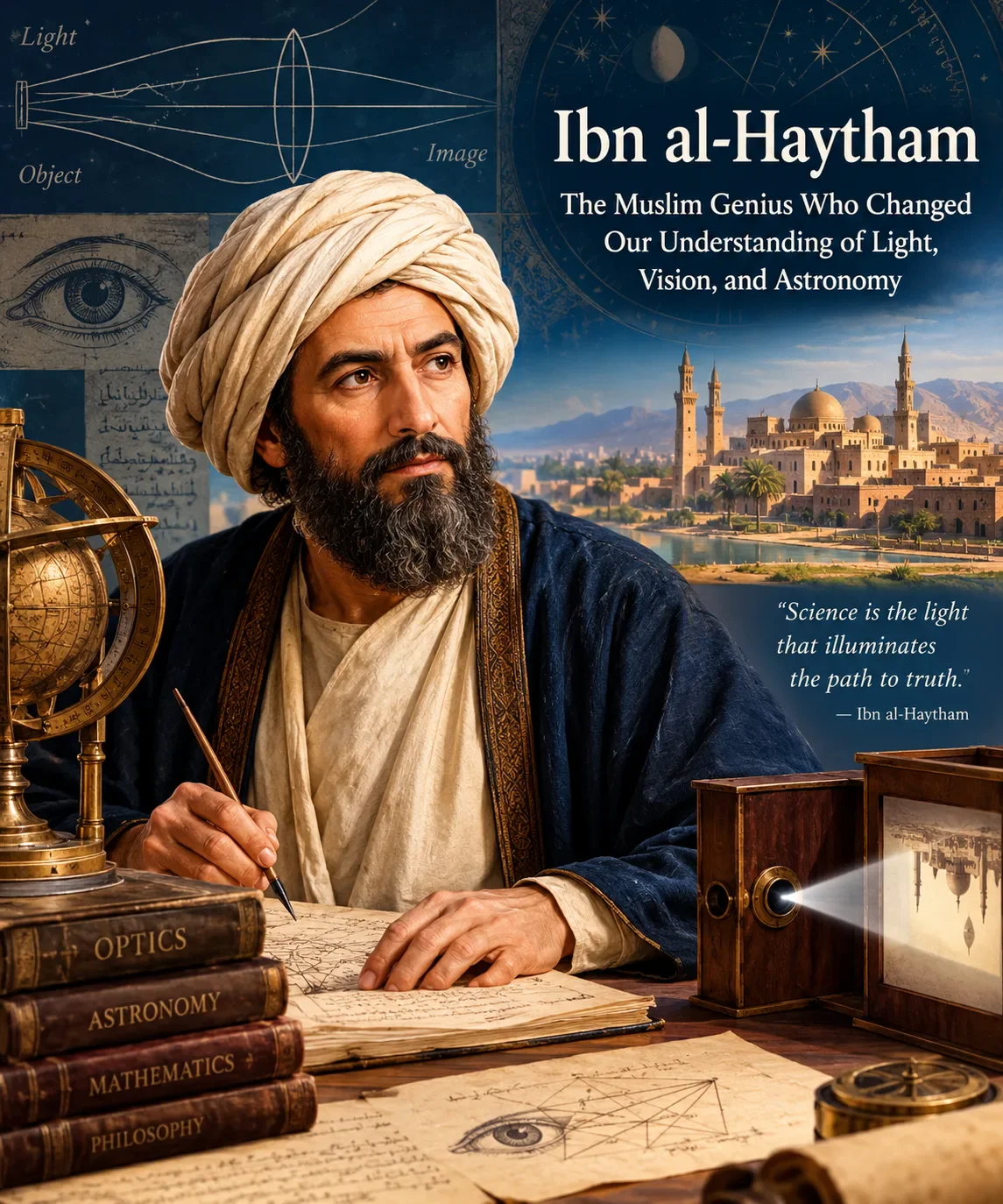
One of the most influential figures in this scientific journey was Ibn al-Haytham, also known in Europe as Alhazen. Living during the Islamic Golden Age, he investigated light, vision, reflection, refraction, and astronomical theories with remarkable intellectual discipline.
His most celebrated work, Kitab al-Manazir, or the Book of Optics, challenged established explanations and helped establish a more systematic approach to studying the natural world. His research influenced later scholars and became an important part of the history of optics.
Yet Ibn al-Haytham's legacy extends beyond his scientific discoveries. His willingness to question established authorities and test explanations against evidence offers a powerful lesson about how scientific knowledge develops.
Who Was Ibn al-Haytham?
Ibn al-Haytham's full name was Abu Ali al-Hasan ibn al-Hasan ibn al-Haytham. He was born around 965 CE in Basra, a major intellectual and commercial center in what is now Iraq. He lived during a period when scholars across the Islamic world were translating, examining, and extending knowledge inherited from Greek, Persian, Indian, and other intellectual traditions.
This flourishing period is commonly known as the Islamic Golden Age. Its scholars made significant contributions to mathematics, medicine, astronomy, philosophy, engineering, and the natural sciences.
From Basra to Cairo
Although accounts of Ibn al-Haytham's early life are incomplete, historical traditions associate his career with Cairo during the Fatimid period.
According to a famous story, he proposed a plan to regulate the flooding of the Nile. After recognizing that the project was beyond the engineering capabilities available to him, he reportedly faced difficulties under Fatimid ruler al-Hakim. Some accounts claim that he spent a period under restricted circumstances before returning to scholarly work.
Because details of this episode come through later biographical traditions, they should be treated cautiously rather than accepted as entirely certain.
Ibn al-Haytham devoted much of his intellectual life to mathematical and scientific investigation. He died around 1040 CE, although exact details of his final years remain uncertain.
His surviving and documented works demonstrate a scholar deeply interested in understanding not only what natural phenomena look like but also how and why they occur.
Ibn al-Haytham's Revolutionary Contributions to Optics
Ibn al-Haytham's greatest scientific achievement was his systematic investigation of light and vision. Before his work, influential Greek thinkers had proposed different explanations for how sight worked.
Some theories suggested that visual rays traveled outward from the eyes toward objects. Other accounts recognized roles for light and the objects being seen but did not provide a complete explanation of the visual process.
Ibn al-Haytham approached the problem differently.
The Book of Optics: A Landmark in Scientific History
His major work, Kitab al-Manazir, is a seven-volume treatise that examined the behavior of light and the process of seeing. It combined mathematical analysis with observations of visual phenomena and investigations of reflection and refraction.
The work is widely recognized as a landmark in the history of optics. Its importance lies not simply in its conclusions but also in how Ibn al-Haytham developed and supported his explanations.
Rather than accepting traditional ideas because respected scholars had proposed them, he examined whether their claims could explain observed phenomena.
The Book of Optics later circulated in Latin translation, becoming known in medieval Europe as De aspectibus and under titles associated with Alhazen.
Its influence helped shape subsequent European discussions of light, vision, and visual perception.
Source: MacTutor History of Mathematics Archive, University of St Andrews.
How Does Human Vision Work?
One of Ibn al-Haytham's most important insights was that vision occurs when light reaches the eyes from visible objects.
Consider looking at a tree in daylight. Sunlight illuminates the tree, and light reflected from its surface enters your eyes. Your visual system then processes this information, allowing you to recognize the tree.
Ibn al-Haytham's explanation represented a major advance over theories that relied on rays emitted by the eyes.
His account was not identical to modern vision science. He lacked knowledge of several biological mechanisms discovered much later. Nevertheless, his emphasis on light entering the eye was a crucial step toward a more accurate understanding of sight.
He also investigated how visual perception can be affected by factors such as distance, illumination, and the conditions under which an object is observed.
Reflection, Refraction, and the Camera Obscura
Ibn al-Haytham studied reflection, in which light changes direction after striking a surface, and refraction, in which light changes direction when passing between different materials.
These phenomena help explain everyday experiences. A mirror produces a reflected image, while a straw partly submerged in water appears bent because light changes direction as it travels between water and air.
His investigations combined geometrical reasoning with experiments designed to examine how light behaves.
He also discussed the camera obscura, an arrangement in which light passes through a small opening into a darkened space and forms an image of the outside scene. This phenomenon had been observed in different forms before and during his era, but his analysis contributed to the scientific understanding of image formation.
The camera obscura became important in the longer history of optical instruments and photography.
It is important, however, not to confuse this early optical arrangement with the invention of the modern photographic camera, which required much later technological developments.
Ibn al-Haytham and the History of Astronomy
Although Ibn al-Haytham is best known for optics, he also made important contributions to the history of astronomy. His astronomical writings reveal a scientist concerned with a difficult question: can mathematical models accurately describe the physical structure and movements of the heavens?
Ancient astronomers had developed sophisticated mathematical systems to predict the positions of celestial bodies. Claudius Ptolemy, whose work profoundly influenced astronomy for centuries, used complex geometrical models to explain planetary motion.
These models could produce useful predictions, but Ibn al-Haytham questioned whether their mathematical arrangements consistently represented physically possible celestial motions.
Challenging Ptolemy's Astronomical Models
In Al-Shukuk ala Batlamyus, commonly translated as Doubts Concerning Ptolemy, Ibn al-Haytham examined inconsistencies in Ptolemy's astronomical and optical writings.
His criticism was not simply a rejection of ancient scholarship. Instead, he examined whether the mathematical explanations and proposed physical arrangements agreed with one another.
Some astronomical models used geometrical devices, including the equant, to account for observed planetary movements. Ibn al-Haytham questioned whether such devices were compatible with the physical principles that astronomers themselves accepted.
His work illustrates a significant development in scientific thought: a mathematical model should not be judged only by its ability to produce calculations. Scientists must also ask what the model means physically and whether its assumptions are coherent.
Research into medieval Islamic astronomy has identified Ibn al-Haytham's criticism as part of a wider intellectual effort to reform planetary theory.
Source: Christian Houzel, “The New Astronomy of Ibn al-Haytham,” Arabic Sciences and Philosophy, Cambridge University Press.
Understanding the Limits of His Astronomical Legacy
Ibn al-Haytham did not invent modern astronomy, discover the telescope, or establish the modern heliocentric system. He worked within the astronomical traditions available in his time, and he continued to accept important elements of the geocentric cosmology inherited from earlier scholars.
His contribution was more specific and historically significant: he exposed weaknesses in established astronomical explanations and encouraged further investigation into the relationship between mathematics and physical reality.
This critical approach became part of the broader history of astronomical reform in the medieval Islamic world.
The Scientific Method: Why Testing Ideas Matters
One of Ibn al-Haytham's most enduring legacies is his approach to scientific inquiry.
Modern science relies on a process of asking questions, proposing explanations, making predictions, conducting tests, and evaluating results. Although scientific methods have developed over many centuries, Ibn al-Haytham's work demonstrates several important elements of this approach.
Observation Before Assumption
Ibn al-Haytham understood that a convincing explanation must account for observable evidence. An idea should not be accepted merely because it comes from an influential philosopher or fits an established tradition.
In his investigations of light, he used controlled arrangements and observations to examine how visual phenomena occurred.
For example, studying light passing through a small opening into a darkened space allowed investigators to examine how light travels and how images form under particular conditions.
Combining Mathematics With Experiment
Observation alone does not always explain why something happens. Mathematics can help identify relationships, describe patterns, and derive predictions that can then be compared with experience.
Ibn al-Haytham combined geometrical reasoning with experimental investigation, especially in optics.
This combination was important because it connected abstract explanations to measurable physical phenomena.
His approach should not be described as the sole invention of the modern scientific method. Scientific inquiry developed through the contributions of many thinkers across different cultures and historical periods.
Nevertheless, Ibn al-Haytham stands among the important medieval scholars who demonstrated the value of systematic investigation, critical reasoning, and evidence-based explanations.
His Most Important Scientific Works
Ibn al-Haytham produced writings covering several mathematical and scientific subjects. The following works help illustrate the range of his interests.
1. Kitab al-Manazir — The Book of Optics
His best-known work examines light, visual perception, reflection, refraction, and the geometrical principles involved in seeing.
Its later Latin transmission helped introduce important ideas from Arabic-language optics to European scholars.
2. Al-Shukuk ala Batlamyus — Doubts Concerning Ptolemy
This critical work examines problems and inconsistencies in Ptolemy's astronomical and optical theories.
It demonstrates Ibn al-Haytham's interest in evaluating established explanations rather than accepting them without scrutiny.
3. Fi Hay'at al-Alam — On the Configuration of the World
This work presents a systematic account of the structure of the world and the arrangement of the heavens within the astronomical and cosmological framework of its period.
It is significant for understanding how Ibn al-Haytham approached the physical interpretation of astronomy.
4. Mathematical and Geometrical Treatises
Ibn al-Haytham also investigated geometry, number theory, and mathematical problems. His work on geometrical optics required careful analysis of lines, angles, and spatial relationships.
The full extent of his surviving writings is complex, and historical catalogues attribute numerous works to him. Titles and translations can vary across scholarly editions, so individual attributions should be checked against specialist references.
How Did Ibn al-Haytham Influence Later Scientists?
Scientific knowledge develops through the preservation, translation, criticism, and extension of earlier work. Ibn al-Haytham's writings provide an important example of this process.
The Transmission of Knowledge to Europe
During the medieval period, works from the Arabic scientific tradition were translated into Latin. Ibn al-Haytham's Book of Optics became available to European scholars through a Latin version generally dated to the late twelfth or early thirteenth century.
Known in Latin as De aspectibus, the work contributed to medieval European discussions of vision and light.
Scholars working on optics and visual theory could draw on its analyses, compare its conclusions with other traditions, and develop new arguments.
Its influence is associated with the broader history of European optical scholarship, including the intellectual environment in which later thinkers such as Roger Bacon and Witelo studied vision and light.
These developments were not a simple, uninterrupted transfer of ideas from one individual to another. Medieval European optics drew on multiple sources, and scholars adapted inherited knowledge to their own questions.
Nevertheless, Ibn al-Haytham's work formed an important part of this international history of science.
A Legacy Built on Questions
His influence also demonstrates why criticism matters in scientific progress.
By identifying difficulties in inherited astronomical models, Ibn al-Haytham contributed to a tradition in which scholars examined the foundations of established theories.
Later astronomers continued this work, proposing alternative mathematical arrangements and debating the physical meaning of celestial models.
Scientific advances often emerge not from one dramatic discovery but from generations of researchers identifying problems, refining explanations, and testing new ideas.
Why Ibn al-Haytham Still Matters Today
More than a thousand years after his birth, Ibn al-Haytham remains relevant because many of the questions he explored are central to modern science.
From Medieval Optics to Modern Cameras
Today's cameras rely on optical principles involving light, lenses, image formation, and the control of incoming illumination.
Modern photography uses sophisticated lenses, sensors, electronics, and image-processing systems that did not exist in Ibn al-Haytham's lifetime. Yet the study of how light travels and forms images belongs to the scientific tradition to which his work contributed.
The camera obscura provides a particularly accessible example of how a simple physical phenomenon can reveal a fundamental principle.
The Continuing Importance of Evidence
Modern researchers face questions far more complex than those encountered by medieval scholars, from the behavior of distant galaxies to the development of advanced medical technologies.
Despite these differences, a fundamental principle remains the same: explanations must be evaluated against evidence.
Ibn al-Haytham's work reminds us that authority, confidence, and tradition are not substitutes for investigation.
Students can apply this lesson by asking clear questions, comparing competing explanations, examining reliable evidence, and being willing to revise their conclusions when new information appears.
Rediscovering the Islamic Golden Age
The story of Ibn al-Haytham also challenges the idea that scientific progress belongs to only one civilization.
During the Islamic Golden Age, scholars working across the Middle East, North Africa, and other regions preserved earlier knowledge while making original contributions to mathematics, medicine, astronomy, and natural philosophy.
Their work became part of a wider scientific heritage that crossed languages, religions, and geographical boundaries.
Understanding this history offers a more complete picture of how human knowledge develops.
Conclusion: Ibn al-Haytham's Enduring Scientific Legacy
Ibn al-Haytham was more than a brilliant medieval scholar. He was an investigator who sought to understand the natural world through observation, mathematical reasoning, and the careful examination of explanations.
His Book of Optics transformed the study of light and vision, while his criticism of Ptolemy demonstrated the importance of questioning astronomical models and examining their physical assumptions.
He did not invent every principle associated with modern science, nor did he work alone. His achievements emerged within a rich intellectual tradition and later became part of a much wider history of scientific discovery.
Today, his legacy lives on in the history of optics, the development of astronomical thought, and the continuing importance of evidence-based research.
His story offers a timeless lesson: progress begins when curiosity leads us to ask questions, when reason guides us to investigate them, and when evidence helps us distinguish a convincing explanation from an unsupported assumption.
Ibn al-Haytham's greatest legacy may be the reminder that understanding the universe requires not only the courage to ask questions, but also the discipline to test the answers.
Explore more stories about the remarkable scholars of the Islamic Golden Age to discover how their ideas helped shape the scientific world we know today.
تابع جديد K Q
اختر إشعارات الموقع أو البريد أو الاثنين. الزائر يقدر يشترك ببريده دون تسجيل حساب.
الإبلاغ عن المقال
لو لاحظت مشكلة في المحتوى، أرسلها لفريق المراجعة. لن تظهر بياناتك لكاتب المقال أو للقراء.
تعذّر إرسال البلاغ الآن. حاول مرة أخرى لاحقًا.
سجّل الدخول لإرسال بلاغ







النقاش
التعليقات (0)
فكرة تضيفها، أو سؤال يفتح حوارًا.
الرجاء تسجيل الدخول لتتمكن من التعليق