The Date Seller Who Was Visited by Umar
Anger in the Market
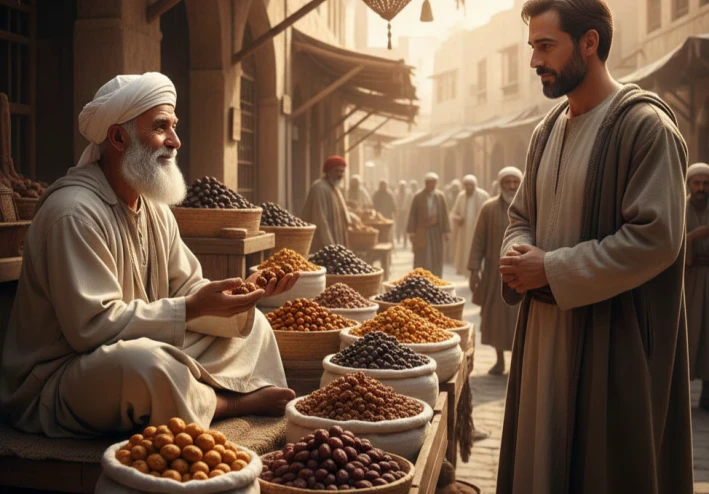
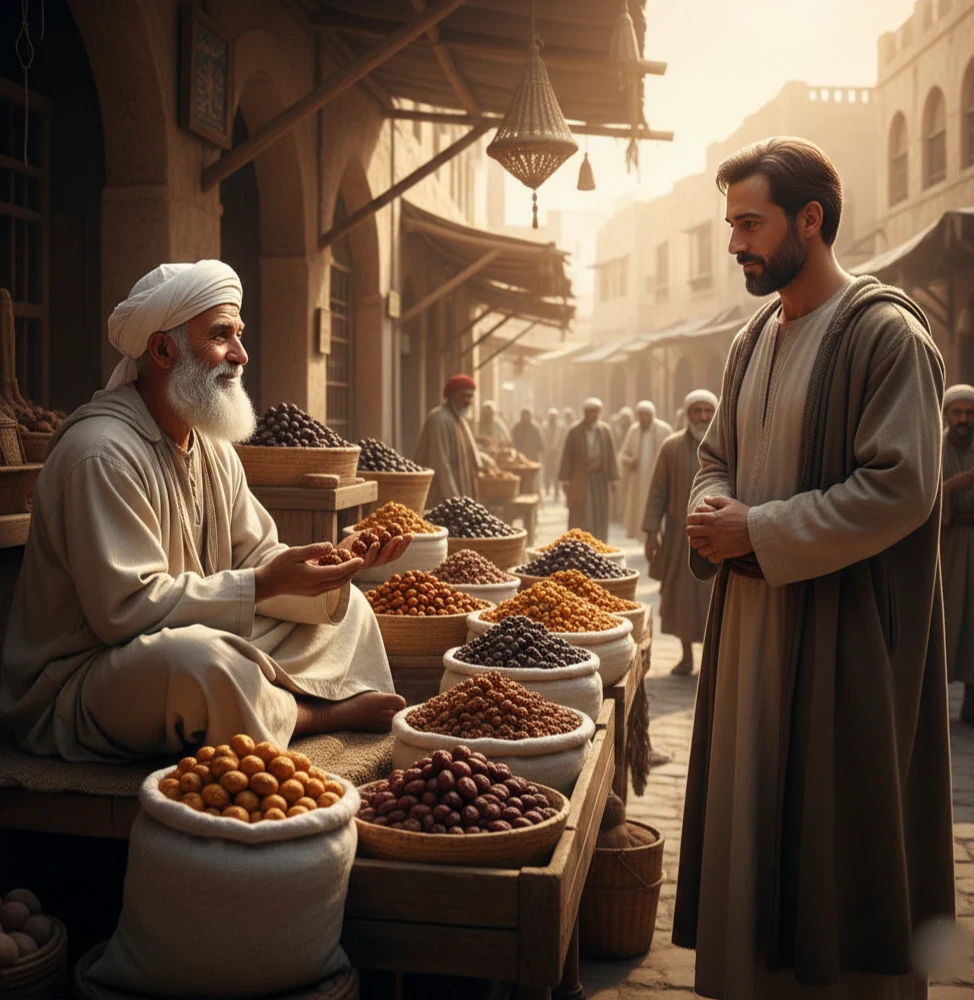
The market of Medina boiled with the day's movement, dust flying from under feet and garments, cries colliding in the air: "Good dates!", "Come close, you who seek blessing in your trade!". The Commander of the Faithful, Umar ibn al-Khattab – may God be pleased with him – was making his rounds through the alleys and shops as was his habit, his eyes like two beams of light, searching for injustice even if it lay beneath a stone. He did not rule from atop a throne; he ruled from among the stones, the dust, and the sweat of brows.
He reached a small date shop. The man stood like a mountain, inspecting the displayed pile of dates with his piercing gaze. He noticed something. He extended his large hand, strong as an axe, into the pile. He turned over a handful of the dry, vibrant dates on top to reveal what lay beneath: moist, inferior dates, nearly spoiled. The deception was as clear as the sun. The seller had covered the bad with the good to cheat the buyers.
Umar's eyebrows rose, and his lips tightened into a single straight line. He tapped his index finger on the shop counter with a tap that made the cups ring. "What is this?!" His voice wasn't loud, but it cut through the market noise like a knife. The seller turned, a young man in the prime of his life, panic drawn on his face like waves on sand during a storm.
The Story Hidden Beneath the Bad Dates
Umar took the seller to the side of the shop, away from people's eyes. "You cheat the Muslims?!" he asked him. The word "cheat" was heavy as Mount Uhud. The young man's head bowed, but he said nothing. "Answer!" Umar commanded. Then, the young man's head rose, and in his eyes was a glimmer not of tears, but of something else, something like wounded dignity mixed with despair.
The young man began to speak, his words stumbling out, as if afraid of the light:
“O Commander of the Faithful... the story is not as you see. I do not own this shop. I am a hired worker. The shop owner is the one who orders me to do this. The good dates on top are new ones he bought. As for this inferior stuff underneath, it's leftover from a previous season, old dates he couldn't sell. He orders me to cover the old with the new to sell it and get rid of it.”
He said it with courage wrestling fear in his voice. Then he added, lowering his voice further: “And he threatened me... if I didn't... he would fire me from the job. And he wouldn't pay my delayed wages.”
Umar fell silent. He looked at the young man's hands, saw the marks of toil on them. He looked at his simple, dusty garment. This was not a professional thief; this was a poor livelihood caught between the jaws of an owner's greed and a poor man's fear.
Justice That Seeks the Roots
Umar did not shout, nor did he punish. He left the market with his wide strides, the young man behind him, his heart trembling. He did not go to the palace. He went directly to the house of the shop owner. The man was wealthy, his house of good stone, in a quiet alley far from the market's clamor.
Umar knocked on the door. The homeowner came out, and when he saw the Caliph himself on his doorstep, his face paled and his hands shook. He ushered them into the house. They sat in the courtyard under a lemon tree. Umar did not begin with accusation. He began with questions, in the style of Naguib Mahfouz discovering the interiors of souls: "How is the date trade this season?". "How is your family?". The man answered hesitantly, as if walking on silk ropes over fire.
Then, with terrifying calm, Umar said: "Tell me about your hired worker in the market. The young man." The man became more flustered. Then, Umar pulled from his pocket a handful of those inferior dates and placed them on the table between them. The handful spoke louder than any sermon.
The man broke down. He confessed. He said he was losing money on the old dates, so he thought of this trick. He thought it was just "business savvy". Umar looked at him with a long look, the look of a judge who weighs the soul before weighing the crime.
The Decision That Wasn't in the Law
Umar said to the wealthy man: “Loss in money is measured in dirhams and dinars. But loss in trust is measured in faith and the Fire. Do you know what almost happened? This young man was almost lost between your oppression and my anger. I would have flogged him with the punishment for fraud, and perhaps imprisoned him. And all of Medina would have cursed his name. All this so you could save a few dirhams?”
The silence was heavy. Then Umar issued his verdict, a verdict as deep as a well:
1. The young man's delayed wages were to be paid immediately, with additional compensation for the threat.
2. All the inferior dates were to be taken from him and distributed to the poor of the neighborhood; he had no right to sell them.
3. The man was to go with Umar to the market and declare before the people that he was the one who ordered the fraud, to clear his employee's name.
But the fourth decision was the most important. Umar looked at the young man and said: “You do not return to work for him. I will give you seed capital from the public treasury to start your own business. Small, but it will be yours, and your sustenance will thrive in it, God willing.”
Lessons in the Narrow Alley
They left the house. The wealthy man carried out all he was ordered to do. His confession before the people in the market was harsher for him than a lash. As for the young man, the world was being remade before his eyes.
In the evening, as Umar was in his prayer niche, he contemplated the lesson. Justice is not merely punishment. True justice is to search for the "why" before issuing the "what". It is to see the human behind the sin, the need behind the crime, the despair behind the wrongdoing. The story of the date seller wasn't about fraud; it was about fear, poverty, and power. And the ruler's role was to fix the flaw from its roots, not merely to cut off the wilting leaves.
That night, Umar wrote instructions to his governors in the provinces: “If a matter involving transgression comes to you, seek its cause. For the hungry man may be a thief, the fearful man a fraudster, the oppressed man a rebel. Fix the cause, and you fix the deed.”