The Patience that Forged a School: The Ordeal of Imam Ahmad ibn Hanbal
The Ordeal: When the Body Becomes an Argument
Let us view this through the lens of a philosopher seeking the meaning underlying the event: "The Ordeal of the Createdness of the Quran" during the reigns of Al-Ma'mun and Al-Mu'tasim was not merely a theological dispute. At its core, it was a crisis of authority. The Abbasid state, in its quest to solidify its intellectual legitimacy along Greek rational lines, sought to impose a single interpretation of doctrine: that the Quran is created. Here, a religious question transforms into a political tool. Imam Ahmad was not flogged, dragged through the markets, and imprisoned for years simply because he rejected a juristic opinion. He was punished because he refused to let religion become subservient to the state, and faith subjected to the whims of the ruler.
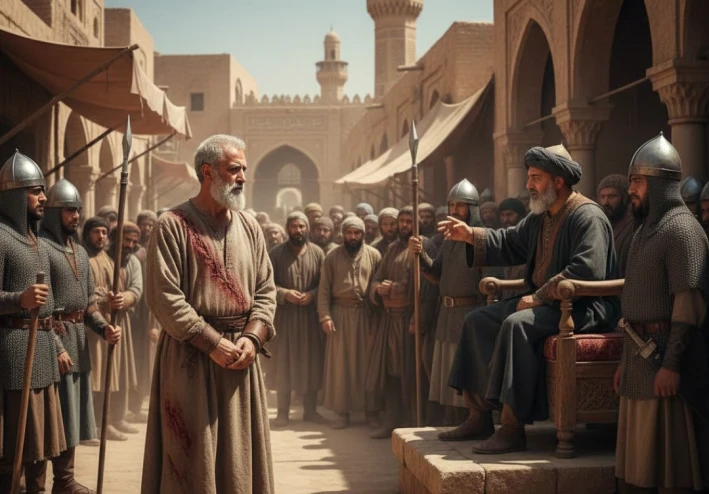
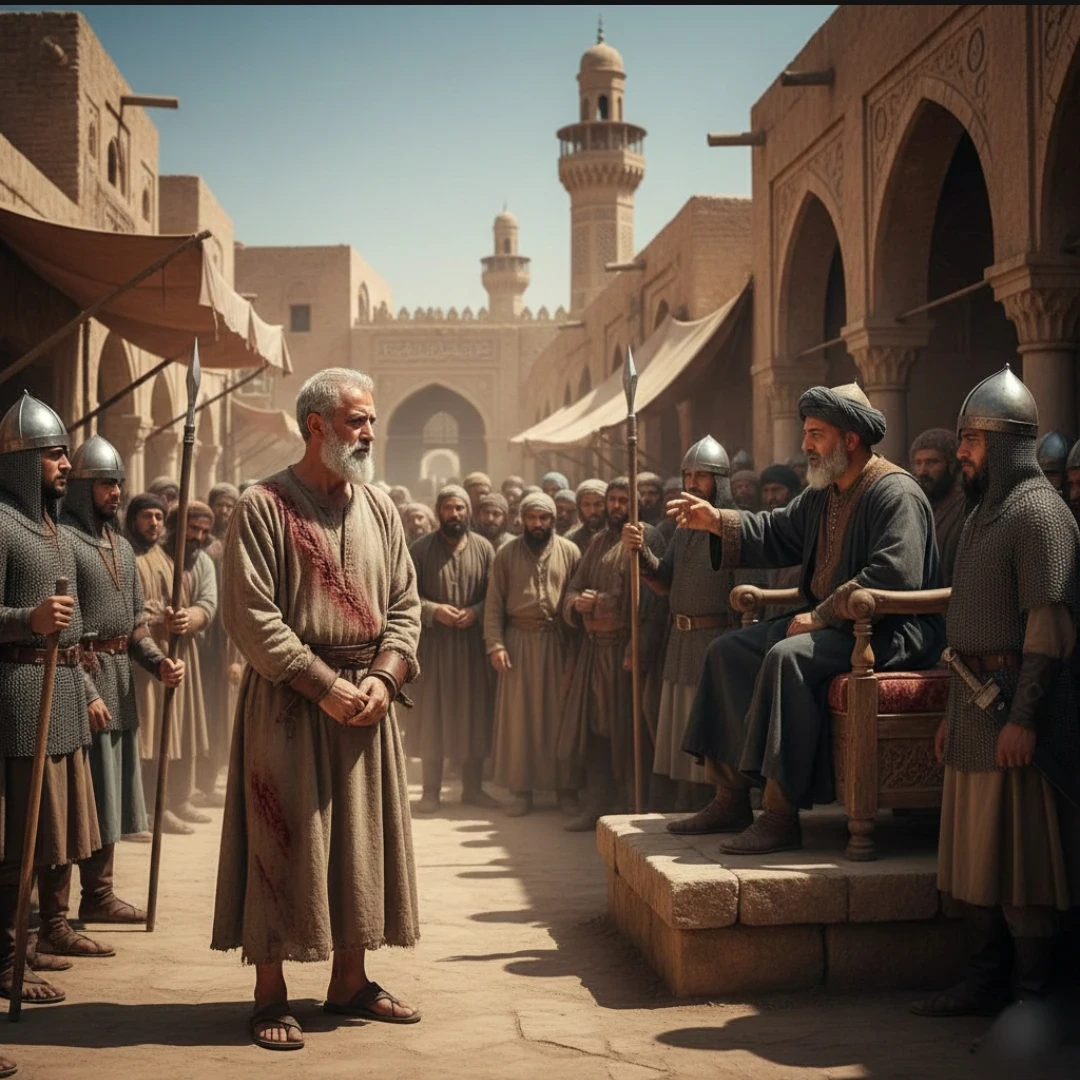
Contemplate this image: a man of frail body but iron will, bound in chains, facing a massive state apparatus backed by philosophers and theologians. Is this not the essence of the eternal conflict between conscience freedom and the tyranny of power? Imam Ahmad transformed his body into a "living proof," a palpable argument. Every lash of the whip was not just pain; it was a word in a clear message: “Truth is not measured by the strength of its supporters, but by the steadfastness of its bearers.”
It culminated in the decisive moment. Imam Ahmad stood alone in the great arena of trial, before Caliph Al-Mu'tasim, surrounded by commanders, soldiers, and hired scholars. Political reason said: one word from your lips, "The Quran is created," and you gain your freedom, your status, and perhaps a position. But the deeper faith-based intellect said: This is not just a word; it is the principle of existence. The utterance would become reality, and the concession would set a precedent that melts all the constants of the Ummah. So, he endured, remained silent, and persevered.
Steadfastness: A Psychological Anatomy of the Power to Refuse
What grants a human such unprecedented strength? Here, we must delve into Imam Ahmad's psychological and intellectual makeup. He was a jurist who combined two methodologies: that of the faithful transmitter of the Sunnah with utmost precision, and that of the rational thinker who weighs matters on the scale of public interest and reality. His refusal was not a mere traditionalist reaction; it was a rational, calculated stance. He understood that accepting the idea of the "created Quran," even if it seemed a verbal issue to some, would open a door that could not be closed: the interpretation of all texts according to the whims of successive rulers. Doctrine would become flexible to the point of fracture, and religion would become a tool in the hands of princes.
Thus, his steadfastness was a defense of rationality itself against the false rationality dressed in philosophy to serve despotism. Through his actions, he declared: "There is a red line the intellect must not cross: the definitive text." This stance made him not only a popular hero but a symbol of the Ummah's intellectual independence. The people, groaning under authority, saw in him the embodiment of their silent refusal. His ordeal transformed into a collective epic.
The Legacy: From Ordeal to School
We would not be exaggerating to say that the Hanbali School was born from the womb of that ordeal. Imam Ahmad's ideas were not merely recorded juristic opinions; they were the culmination of a highly charged human experience. The patience he acquired in prisons became a methodology in dealing with texts: deliberation, verification, and rejection of haste. The suffering he endured brought him closer to the concerns and real-life problems of the common people, so his jurisprudence became characterized by clarity, simplicity, and rigor in the rights of people alongside tolerance in the rights of God.
Look at his legacy: He did not conquer with an army, nor did he found a state, but he founded an intellectual and ethical school that spanned centuries. His students, like Imam Ibn Taymiyyah and Imam Ibn al-Qayyim, were extensions of that spirit resistant to deviation and defending pure creed. To this day, everyone who stands against attempts to dissolve religious constants or exploit religion draws—consciously or not—something from the spirit of Ahmad ibn Hanbal on that day in the arena of trial.
Philosophical Conclusion: The ordeal of Imam Ahmad reminds us that the greatest victories of thought do not only occur in lecture halls; they sometimes happen in arenas of torment. And truth, when a human is so imbued with it that it becomes part of their biological being, becomes a weapon no swords can defeat. The Imam's victory was a victory of meaning over force, of the long passage of time over the fleeting moment.