A Mind in the Mirror of the Heart: The Story of the Logician Who Met the Mystic
The Intellectual Mission: When the Palace Sends Reason to Examine the Heart
In the court of the Abbasid Caliph, where conspiracies were woven with threads of gold and paper, and where the world's affairs were resolved with a glance from a chamberlain or a nod from a vizier, a simple event occurred—like a grain of sand—but it caused a crack in the wall of firm certainty.
A man in patched clothes came, asking a single question: “What is the difference between one who knows God, and one who loves God?”
A question like a cipher. It passed by the ears of the court, and they thought it naive. But when it was repeated, daily, at the same time, it began to cause intellectual discomfort to the entourage. The question was not directed at consciences, but at concepts. It did not ask for money, but for an answer. It was an anxiety in the guise of a beggar.
The Caliph decided to refer the matter to the state's intellectual apparatus: he sent for Abu Yusuf Yaqub ibn Ishaq al-Kindi, the Philosopher of the Arabs, the renowned master of logic, who represented the pinnacle of rationalism in his era. The mission was clear: analyze the mystic's question, refute it logically, and return it to the acceptable fold of "naivety," or answer it in a way that satisfies the mind and silences the heart.
Al-Kindi left the palace, having scrutinized with the scrutiny of scrutineers and pondered all possibilities. His mind was like a precisely crafted machine, processing the case of "Knowledge versus Love" through the cogs of Aristotelian logic: definitions, genus, differentia, property, accident. He was confident that the question belonged to the category of "emotional rhetoric" that could not withstand philosophical examination.
The Meeting in the Shade: When Logic Falls Silent for Existence to Speak
Al-Kindi went to the simple corner of the mystic on the outskirts of Basra. He found no palace, no students, no library. He found a man sitting under a palm tree, his face clear like fresh water, his eyes shining with a strange glimmer: not the sharp glint of acute intelligence, but the light of deep peace.
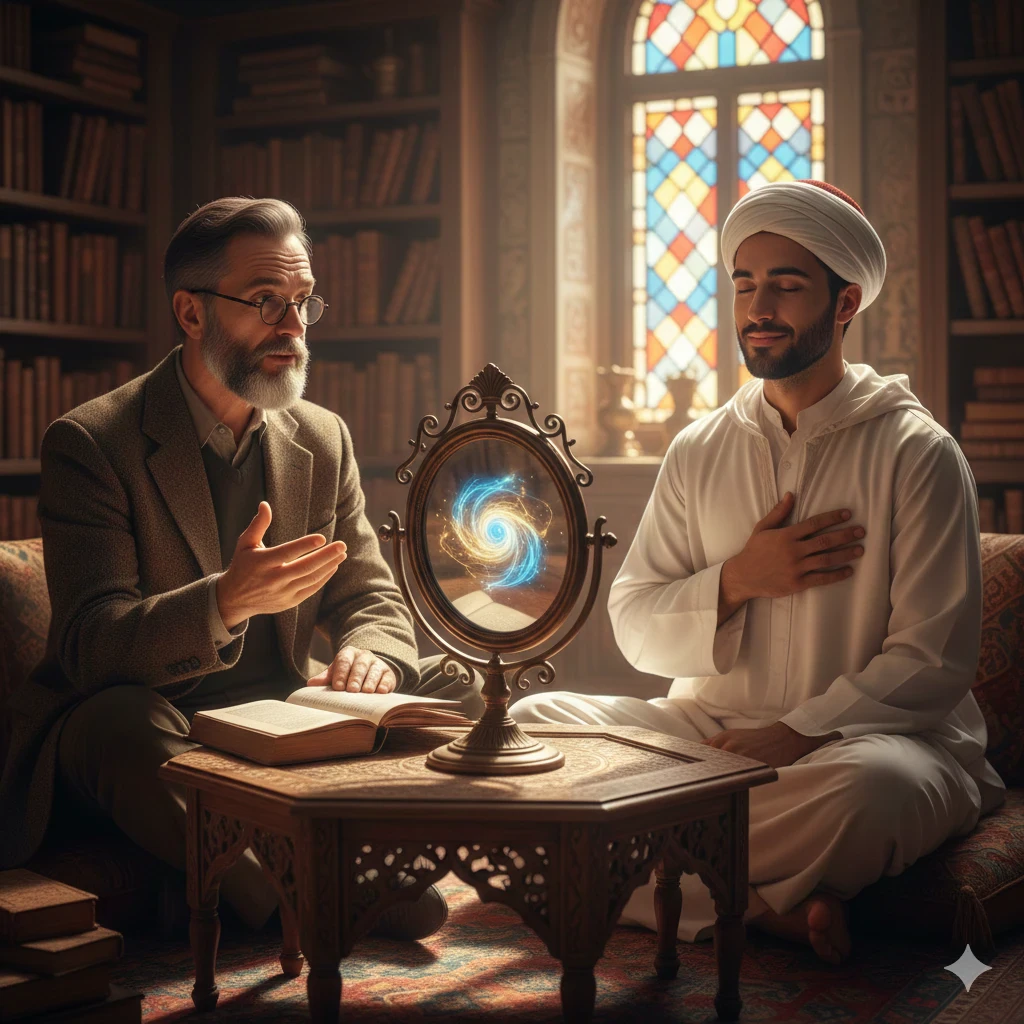
Al-Kindi asked, launching his logical attack: “I heard you ask a question about the difference between knowledge and love. Is not knowledge the foundation, and love a consequence of it? So how can they be separate?”
The mystic looked at him, smiling as a wise mother smiles at a child asking about the secret of birth, and said: “O wise one, tell me: you know everything about honey: its color, consistency, components, benefits, and even the chemical equations describing the breakdown of its sugars. Does this quench your thirst?”
Al-Kindi was momentarily confused, then replied: “No, of course not. Knowing about it is one thing, tasting it is another.”
The mystic said: “There, you have answered. The whole world knows about God through the intellect. They read, analyze, demonstrate. This is like one who reads a book describing honey. As for the lover, he is the one who has tasted. No matter what you tell him about honey, he will nod in agreement, but his certainty does not come from your words; it comes from a sweetness in his mouth that cannot be denied. The lover knows God by the taste of the heart, just as you know honey by the taste of the tongue. The rational knower knows Him by the proof of the intellect, just as you know it by the description in books.”
Al-Kindi fell silent. The answer was astonishingly simple, yet it pierced all his logical defenses. The mystic had spoken the language of experiential certainty, a language Al-Kindi had considered "unphilosophical." But at that moment, he felt he was facing an existential truth, not a theory needing proof.
The Transformation: Returning from the Heart to the Palace with a Different Load
Al-Kindi returned to the Caliph, but not as he had left. He did not bring a "logical report" refuting the question. Instead, he carried a new question in his heart. When the Caliph asked him: “So what is your judgment, O Yaqub?”
Al-Kindi replied after a long silence: “I have judged, O Commander of the Faithful, that the intellect is a great door to wisdom, but the heart is the home. And that man, with his simple question, was not asking about a difference in definition, but a difference in the mode of existence. The scholar lives on the balcony of knowledge, contemplating the garden. The lover lives in the midst of the garden, inhaling the nectar of its flowers.”
The Caliph did not send for the mystic again afterwards. Perhaps he understood, perhaps he did not. But Al-Kindi understood. He realized that philosophy which worships reason and forgets the heart is like building a magnificent palace upon a void. From that moment on, he began to speak in his writings a different language, a language mixing the precision of the mind with the clarity of insight, and wrote late in his life: “The highest degree of knowledge is to know that you do not know, and then to love what you cannot fully comprehend.”