Return to Primordiality: The Tale of the Philosopher Who Found God in the Spider's Web
The Story:
Great tales always begin with a moment of tremor. For Dr. "Nour El-Din," this moment came as he listened to a lecture by his professor at the Sorbonne on "Chance and the Cosmic Mind." The man was a molecular biologist who had presented his thesis on "Random Mutations and Natural Selection," and believed, with the conviction of a staunch materialist, that the universe was a blind machine, and life a coincidental foam on the surface of an ocean of nothingness. But a single question from a novice student shook that belief like an earthquake: "If the human mind is a product of chance, how can we trust its conclusions, including the conclusion of chance itself?"
"Nour El-Din" returned to his lab in Cairo, carrying that question like a shard in his chest. He decided to apply the method of doubt he had learned from Descartes, but this time, with merciless rigor. He would doubt everything, even the holiest tenets of modern science: the "principle of chance." His new project: observing "randomness" in nature.
First Experiment: The Spider's Web
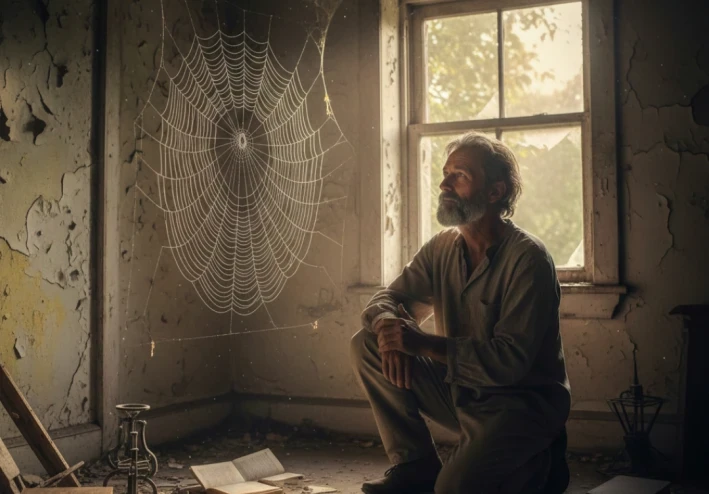
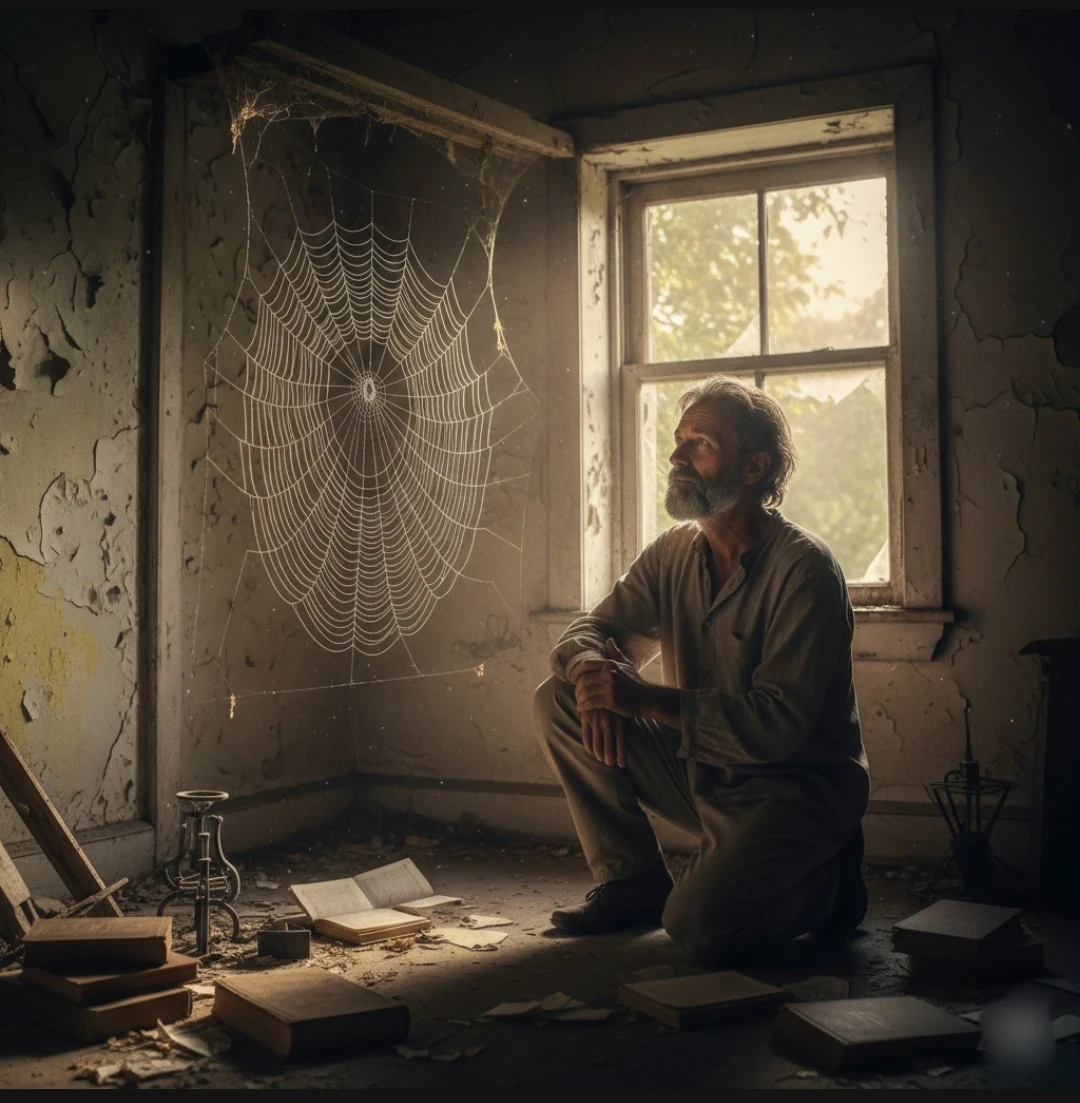
He began with a simple experiment,observing a spider weaving its web in the corner of his lab window. According to equations, the spider's movement in weaving the complex web should be governed by a blind instinct, a product of neural chemical interactions. But what caught his attention was that first thread, the "bridge thread," which the spider releases into the air to attach to the opposite side. How could random winds carry a thread to its target with precision? He observed it a hundred times. Each time, the thread found its way, as if there was some "guidance." He wrote in his notes: "It seems that 'randomness' here is subject to a higher order. The order awaits randomness to fulfill its function, like an intelligent driver using incidental winds to save fuel."
Second Experiment: The Code of Life
From the window to the heart of the cell.He returned to his electron microscope, looking at the DNA code. He previously knew it as a text written in a chemical language, the product of billions of years of beneficial random errors. But his doubt led him to ask another question: "Who decides what is 'beneficial'?" Survival of the fittest? Yes. But in an integrated ecosystem, where the strong depends on the weak, the predator on the prey, and the plant on the insect, doesn't this "integration" point to a prior "design"? And how does random chance explain the emergence of "consciousness," perception, love, and sacrifice in creatures that theoretically aim for individual survival only? He wrote: "Chance may explain the stone, but it fails to explain the inscription on the stone. And life, with its complex informational systems, is the most eloquent inscription the universe has witnessed."
The Transformation: The Moment of Revelation in the Embrace of the Quran
"Nour El-Din"read everything. And on a sleepless night, as he browsed a book on the history of religions, his eyes fell – by chance? – on a verse from the Holy Quran: {Indeed, in the creation of the heavens and the earth and the alternation of the night and the day are signs for those of understanding} [Ali 'Imran: 190]. The phrase "those of understanding" stood before him. It doesn't just mean those with minds, but those with minds that ponder, that connect cause with purpose. Then he read: {We will show them Our signs in the horizons and within themselves until it becomes clear to them that it is the truth} [Fussilat: 53].
He felt the verse was addressing him personally. "The horizons" were the universe he studied, and "themselves" was the biology he specialized in. His scientific research, with its objective doubt, had led him to the threshold of faith. It wasn't a cancellation of the mind, but its completion. Faith wasn't a leap in the dark; it was arriving at the other shore after a long journey in the sea of doubt. "Nour El-Din" prostrated that day, not as a scientist submitting to authority, but as a human who finally realized that the mind granted to him by the "First Cause" could not be an argument against Him, but was the strongest evidence for Him.