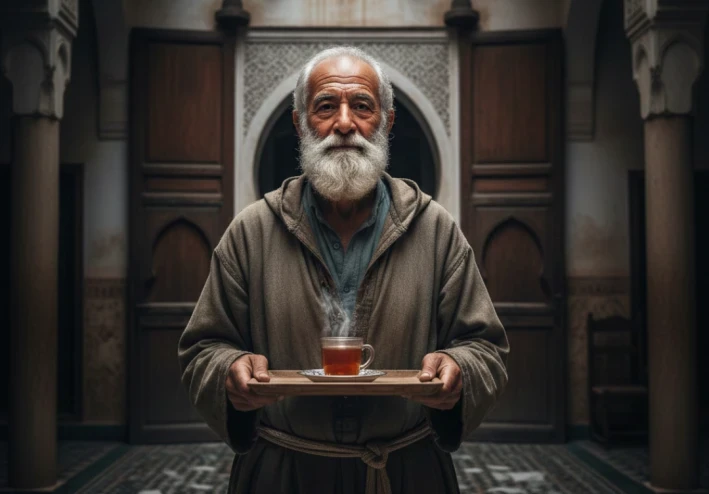
Wisdom in a Servant's Garment
Wisdom: The Absent Presence
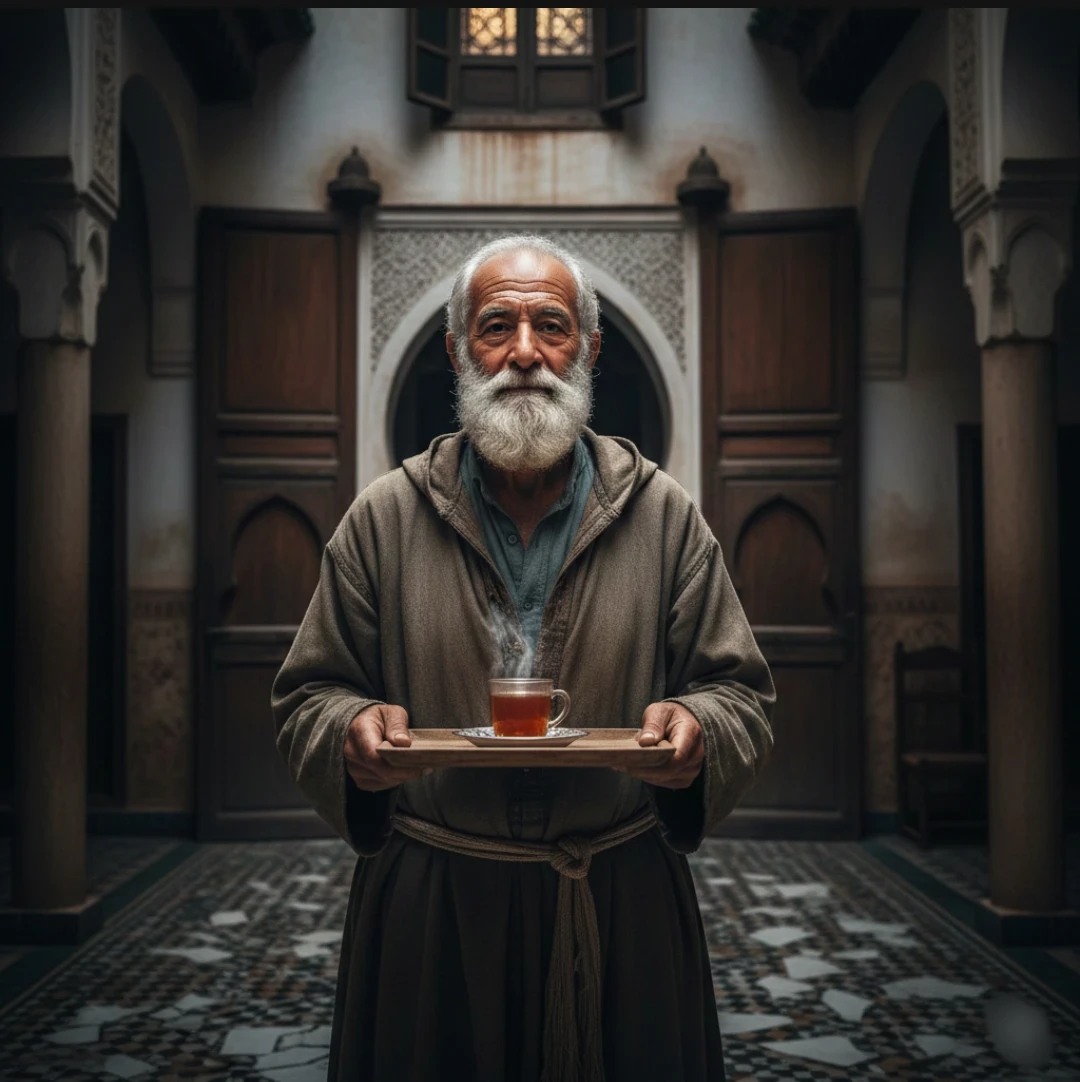
We often search for wisdom in thick books, in vast lecture halls, and on the tongues of philosophers with flowing white beards. We believe that wisdom must appear in an awe-inspiring form, wearing luxurious garments, and speaking complex words akin to riddles. But is not wisdom, in its essence, about placing things in their correct position? Is not the wise one he who knows the limits of his knowledge and knows how to see the truth in its simplest forms?
What happened to Imam "Abdullah ibn al-Mubarak" – one of the great Imams of Islam in the second Hijri century – presents us with a profound philosophical lesson on the nature of knowledge and its sources. Ibn al-Mubarak was an ocean of knowledge, an Imam in Hadith, jurisprudence, and asceticism, traveling thousands of miles to collect a single narration from the Messenger of God ﷺ. Yet, his journey to "Mecca" one year would reveal to him a truth that escapes many learned individuals.
The Journey: Between the World's Clamor and the Heart's Silence
During the Hajj season, people from all corners of the earth gathered in Mecca. Abdullah ibn al-Mubarak was among them, performing the pilgrimage to the Sacred House of God. During that time, he noticed a man who did not attract attention. He was a simple man, wearing modest clothes, serving the pilgrims and fulfilling their needs. He was not among the known scholars or honored dignitaries. He was merely a “servant.”
But Ibn al-Mubarak – with his penetrating insight – saw what others did not. He noticed upon this man a strange "tranquility" and a dignity that did not match his apparent profession. He went about fulfilling people's needs as if performing a great act of worship. His movements were calm, his words few but beneficial, and his eyes emanated a light of serenity.
Ibn al-Mubarak approached him one day and asked – with the humility of a true scholar – a simple question: "Where are you from?" The man replied: "From the people of Basra." Then the Imam asked him – as if trying to discover the secret of this tranquility – about his condition and the reason for his annual pilgrimage. So, the unknown man began to tell his story.
The Hidden Story: When the Lesson is in the Deed, Not the Word
The man said: I was in Basra working in service to people, and I – like many young men – was neglectful of prayer, distant from God. One day, while I was in the market, I saw a written piece of paper thrown on the ground. I picked it up – I don't know why – and read what was on it. It contained a verse from the Book of God: ﴿Has the time not come for those who have believed that their hearts should become humbly submissive at the remembrance of God?﴾ [Al-Hadid: 16].
This single verse! A few words, but they pierced my heart like an arrow. I stood as if stunned, as if the verse was being recited to me for the first time. "Has the time not come? Has the time not arrived?" I felt my shortcomings, my distance, my wasted life. I went to my home, performed ablution, and prayed. From that moment, my life turned upside down. I realized that God calls us gently: “Has the time not come yet?”
The man said: So I decided to repent sincerely. But I wanted to atone for the years of negligence. I asked: What is the best deed that brings me closer to God? I was told: Pilgrimage to the Sacred House of God. But I was poor; I did not have the expense for Hajj. So I thought: I will serve the pilgrims on their journey, fulfill their needs, and donate to them my effort and time. Thus, I made Hajj my annual work, serving people in it and drawing closer to God by serving them.
The Revelation: Discovering a Treasure Under the Rubble
Abdullah ibn al-Mubarak listened to the story attentively. Then he looked at the man with the gaze of a scholar who has discovered a rare manuscript under rubble. This man's wisdom lay in "action," not in "speech." He understood religion in its true essence: worship, work, and benevolence.
Ibn al-Mubarak asked him: "Did it ever occur to you to seek knowledge or sit with scholars?" The man replied – with a humility that concealed great depth –: “O Sheikh, God has bestowed repentance upon me, and I am busy being grateful for this blessing. I serve the pilgrims, remember God, and try to be a righteous servant. And this is what my knowledge and capacity have afforded me.”
Ibn al-Mubarak whispered to himself: This is true wisdom. This simple man, who neither reads nor writes, has understood from religion what many learned individuals have not. He understood that religion is "interaction," "service," and "benefit to people." He is applying the Prophetic hadith: «The best of people are those who are most beneficial to people.»
The Philosophical Lesson: Theoretical Knowledge and Practical Knowledge
Here lies the difference between two types of knowledge: theoretical knowledge accumulated in books, and practical knowledge embodied in behavior. The servant man embodied practical wisdom, while Ibn al-Mubarak – with his vast knowledge – was searching for the essence of wisdom. Their meeting was a moment of completion: the completion of knowledge with application, and theory with experience.
The servant man departed, and Abdullah ibn al-Mubarak remained in thought. He came for Hajj to perform Tawaf and Sa'i, but he found another treasure: a lesson in "the humility of knowledge." For true knowledge does not give its possessor arrogance; rather, it opens his eyes to see wisdom wherever it may be. Wisdom may lie in a kind word from a servant, a grateful glance from a needy person, or a simple heart filled with the love of God.