The Grandson of Caesar: The Companion Who Bought Paradise with His Heart
The Lukewarm in the Shadow of Caesars: Uphringing and Search
Suhaib ibn Sinan Al-Rumi – may God be pleased with him – was not born into the embrace of freedom, but rather into the shackles of an empire that knew only the language of the sword and the cross. He grew up in the palaces of the Caesars, where slavery was crafted from the finest silk and the heaviest chains. He was a Roman slave, with his fair body and blue eyes, but his soul was searching for a master other than Caesar, and a worship not dedicated to idols or tyrants. His heart was like a captive bird in a golden cage, singing a melody only it understood – the melody of monotheism inherited from his Arab origins, whose people had migrated to the land of the Romans.
Thus, Suhaib's character was formed from two contradictions: the appearance of a white Roman, and the essence of an Arab yearning for freedom. The freedom he sought was not merely liberation from human slavery, but a journey to attain the heart's servitude to God alone. He saw emptiness in Roman philosophy, injustice in their strength, and a spiritual poverty in their wealth that filled palaces but emptied hearts.
The Fateful Encounter: Light in the Darkness of Mecca
When Suhaib reached Mecca, after stages of hardship and trade, the city was teeming with more idols than people. But among those mute stones, Suhaib heard a new whisper: the word "Allah" mentioned without association, and "the Messenger" sent without kingship. He heard of Muhammad ﷺ, son of Abdullah, who came with the religion of Abraham, the upright.
Suhaib's meeting with the Prophet ﷺ was a meeting of light with the sun. He did not need complex proofs or philosophical arguments; for when truth appears, it is as simple as a breeze, as clear as the sun at midday. He saw in Muhammad's face the sincerity of the prophets, in his words the justice of rulers, and in his behavior the mercy of fathers. He embraced Islam in the House of Al-Arqam, becoming one of the foremost pioneers, concealing his faith as a starving man hides a morsel of bread, fearing the persecution of Quraysh, who would not accept a rival to the religion of their forefathers.
The Great Escape: Migration and the Price
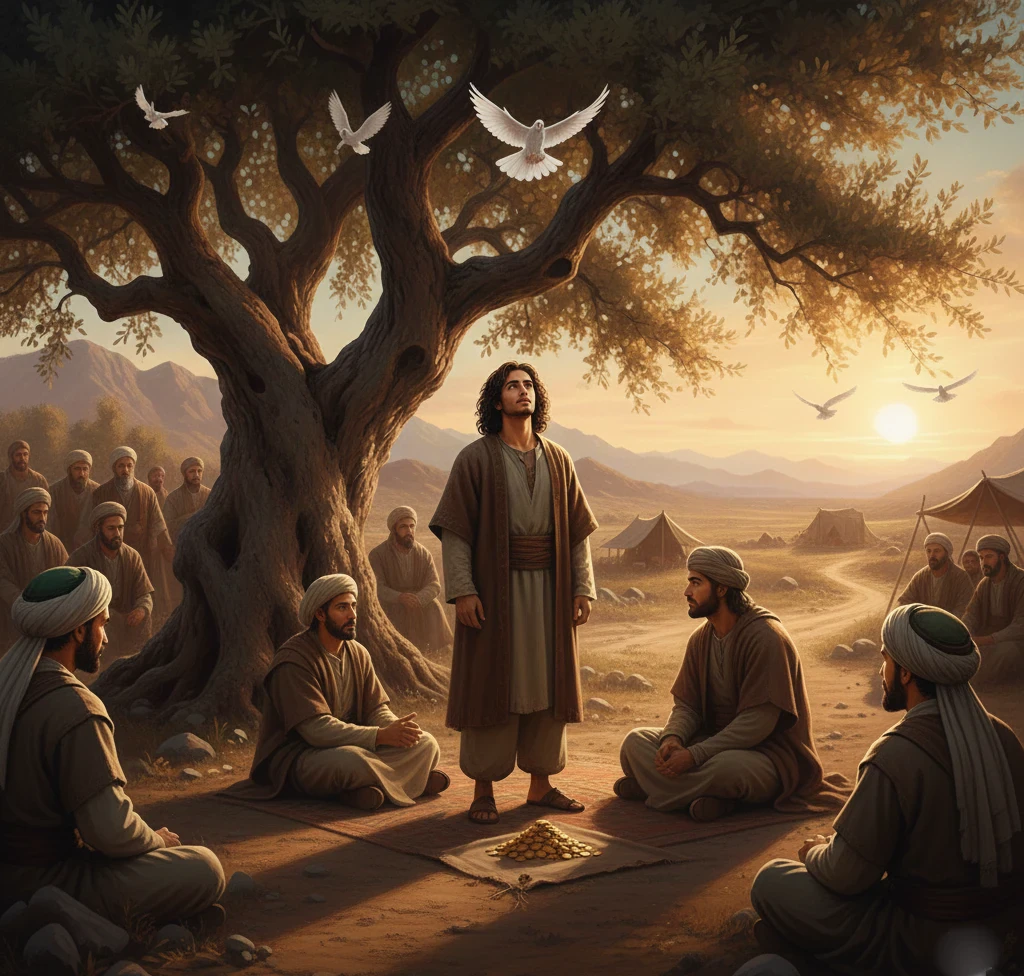
When God commanded His Prophet to migrate to Medina, the Muslims left in groups. Suhaib had prepared himself for the journey, but the eyes of Quraysh were watching him, aware of his status and wealth. They wanted to stop him. So, he gathered all his fortune – gold, silver, and goods – and carried it with him, as if buying his freedom with it.
On the way, horsemen from Quraysh caught up with him and uttered their famous words: "You came to us penniless and became wealthy, and now you want to leave with your wealth and your life?! By God, that will not happen!" Suhaib stood firm; it was the decisive moment of his life. He looked at them with the gaze of one who knows the value of things and said his words that echoed through the valley of history: "What if I leave my wealth to you, will you let me go?" They said: Yes.
He pointed to the place where his treasure was hidden among the rocks and said, "Then it is yours." They took everything and let him go. He sold his entire worldly life for one price: to catch up with the Messenger of God ﷺ.
The Reunion in Quba: The Most Beautiful Transaction
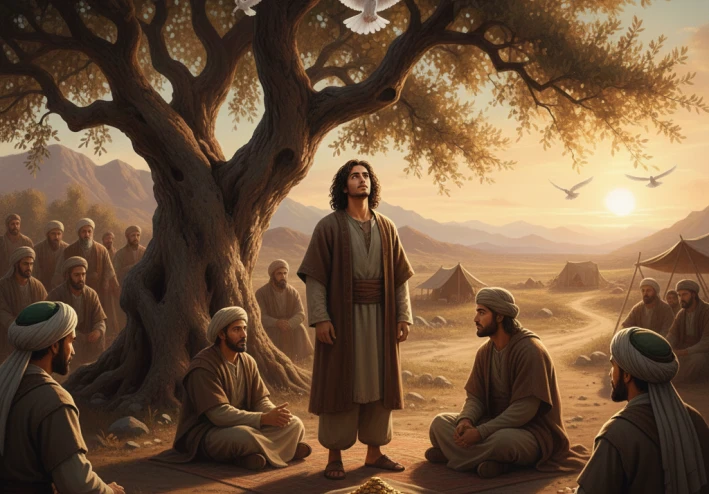
When Suhaib reached Quba, exhausted and hungry, the Prophet ﷺ was sitting with Abu Bakr Al-Siddiq. When the Prophet ﷺ saw Suhaib approaching, he smiled that smile from which lights of acceptance radiated and said to Abu Bakr: "Your transaction has been profitable, O Abu Yahya! Profitable indeed!" These words were the true reward. Suhaib had gained what all the treasures of earth could not equal: the pleasure of God and His Messenger, and the status of companionship.
Later, the companions asked him: "O Suhaib, was your transaction profitable?" (meaning that Quraysh had taken his wealth). He replied with words embodying the philosophy of the true believer: "By God, I did not lose. I bought the pleasure of my Lord and His Messenger, and after that, I fear no poverty ever." He understood that true poverty is the poverty of the heart from faith, not the poverty of the pocket from a coin.
The Legacy: The Essence of Freedom
Suhaib Al-Rumi was not merely a companion who embraced Islam; he was a symbol of true freedom. He taught us that freedom is not in possessing wealth, but in being free from its authority over the heart. And that faith is the profitable transaction after which there is no loss. He – may God be pleased with him – embodied God's saying: (And of the people is he who sells himself, seeking the pleasure of Allah) [Al-Baqarah: 207].
Suhaib lived ascetically regarding what he had lost, grateful for what he had gained, and he was among the companions most beloved to the Messenger of God ﷺ. He died in Medina, carrying with him to his Lord a testimony from His Prophet that he was "among the foremost pioneers." He sold the gold of this world and bought the gold of the Hereafter; he sold the freedom of the body and bought the freedom of the soul.